What does ‘security’ really mean in a world where threats don’t knock, break locks, or scale fences-but slip quietly through credentials, behaviors, and blind spots?
For decades, organizations relied on perimeter-based defenses: locks, gates, firewalls, access cards, and static controls designed to keep threats out. But today’s reality looks very different. Threats don’t wait at the door. They already live inside networks, move laterally across systems, and adapt faster than manual controls can react.
This shift raises an important question: Can traditional security models keep up with an environment that changes every second? Increasingly, the answer is no. The future of security isn’t about building higher walls-it’s about building smarter systems.
Traditional security models were built for a predictable world. Assets stayed in one place. Users logged in from known locations. Systems followed fixed rules. In that environment, perimeter defenses made sense.
Today’s enterprises are distributed, cloud-native, and always-on. Employees work from anywhere. Data flows across platforms. Devices connect and disconnect constantly. Attack surfaces expand with every integration.
Static defenses struggle in this environment because they are reactive by design. They respond after an alert is triggered or a breach is detected. By then, damage is already underway.
Modern security must behave differently. It must observe continuously, learn from patterns, and adapt in real time. This is where intelligence-not hardware-becomes the defining factor.
Intelligent security systems do more than enforce rules. They understand context.
Instead of asking, “Is this user allowed in?” they ask:
By connecting signals across systems, locations, and behaviors, intelligent security shifts organizations from reaction to prevention. This approach lies at the heart of Enterprise Security Intelligence, where data, analytics, and automation work together to reduce risk before incidents escalate.
Artificial intelligence is no longer experimental in security—it is foundational. According to recent estimates, 65% of organizations now report regular use of generative AI, reflecting how quickly AI-driven capabilities are becoming embedded across enterprise functions, including security.
In practical terms, AI enables:
Rather than overwhelming teams with alerts, AI helps prioritize what truly matters. Security teams spend less time chasing noise and more time making informed decisions.
This shift transforms security from a monitoring function into an intelligence-driven discipline.
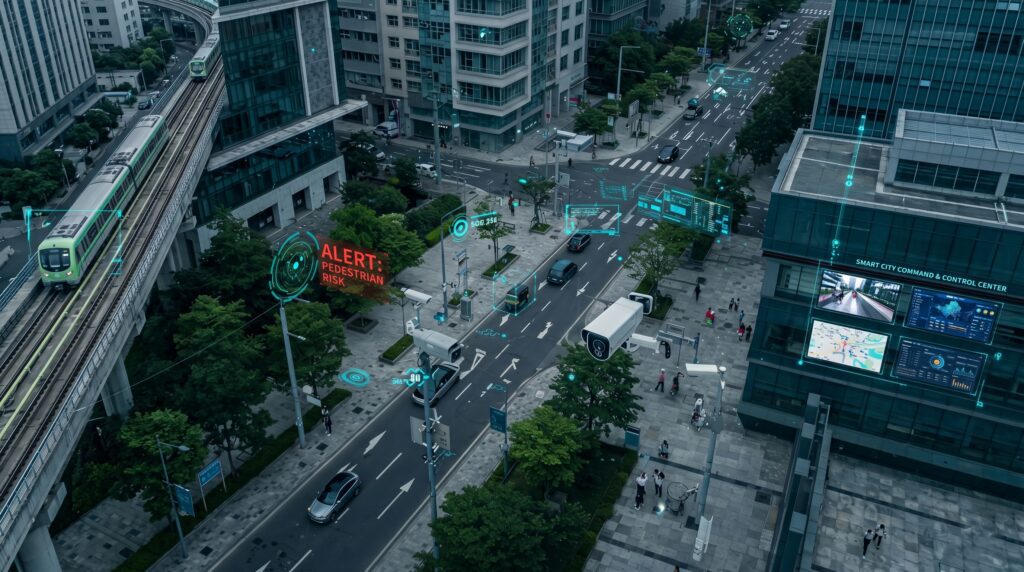
Physical security is undergoing a similar transformation. Cameras once served as passive recording devices-useful only after an incident occurred.
Today, intelligent video systems analyze movement, behavior, and patterns in real time. This evolution is reflected in market momentum: the global video surveillance market is projected to grow from approximately USD 56.1 billion in 2025 to USD 88.0 billion by 2031, at a CAGR of about 7.8%. Growth is driven less by hardware and more by analytics, AI, and integration.
Modern surveillance systems don’t just record events; they interpret them. They can identify abnormal crowd behavior, unauthorized access patterns, or unusual activity flows-turning visibility into actionable insight.
This convergence of physical and digital intelligence strengthens overall enterprise resilience.
Another pillar of intelligent security is the zero-trust model. Instead of assuming anything inside the perimeter is safe, zero trust treats every access request as potentially risky.
Every user, device, and application must continuously prove legitimacy.
Zero trust works best when paired with intelligence. Contextual signals—location, device health, behavior history, and access patterns—allow systems to dynamically adjust trust levels. Access becomes conditional, adaptive, and continuously evaluated.
Within Enterprise Security Intelligence, zero trust is not a checklist—it’s a living system that evolves alongside threats.
Speed is the most underrated advantage in security. The longer a threat goes undetected, the more damage it causes—financially, operationally, and reputationally.
Intelligent security systems reduce this risk by enabling:
This real-time capability is critical in an era where attacks are faster, stealthier, and increasingly automated themselves.
Security teams no longer need to wait for a breach notification. The system surfaces risk as it forms.
As security becomes more intelligent, it also becomes more strategic.
When leaders gain real-time visibility into risk posture, they can make better decisions about expansion, partnerships, and technology adoption. Security stops being a cost center and starts supporting growth, compliance, and operational confidence.
This is where Enterprise Security Intelligence aligns closely with broader digital innovation-helping organizations move faster without sacrificing trust or control.
While automation and AI are powerful, they don’t replace human judgment. Instead, they amplify it.
Intelligent systems handle scale, speed, and complexity. Humans provide context, ethics, and strategic direction. The most effective security models combine both—allowing people to focus on high-impact decisions while machines manage continuous analysis.
Security becomes less about manual intervention and more about informed oversight.
The future of security will not be defined by stronger locks or thicker walls. It will be defined by systems that see, learn, and adapt continuously.
As threats grow more dynamic, organizations that rely on static defenses will fall behind. Those that invest in intelligence-driven security will gain resilience, agility, and trust.
Looking ahead, security will increasingly:
Predict risk instead of reacting to incidents
Integrate physical and digital intelligence seamlessly
Operate autonomously while remaining transparent
Enable growth rather than restrict it
In this future, security is no longer something you install. It’s something that thinks.