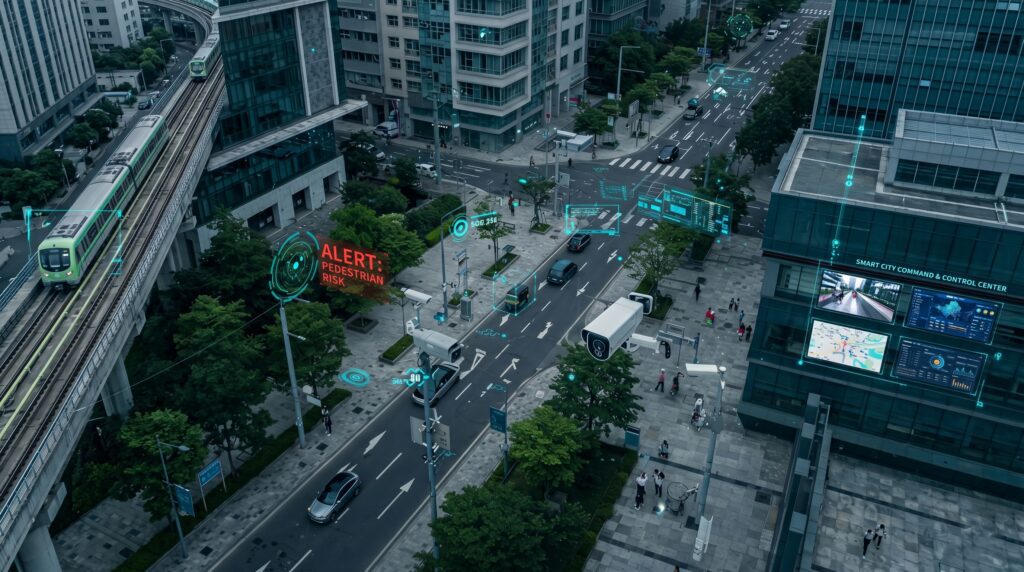
Scaling surveillance across multiple locations is not a matter of stacking screens- each site has its own mix of network constraints, camera types, storage systems, and data silos. The outcome? A mosaic of disjointed systems demanding endless attention and ties on manpower.
That’s why enterprises are increasingly turning to multi-site video surveillance solutions underpinned by AI- where all sites feed into a singular, intelligent ecosystem that doesn’t just see – it reasonably comprehends and acts.
For Large organizations, surveillance isn’t simply a security challenge- it’s about reputation, continuity, and operational confidence. A lapse in one site can cascade, damaging trust and jeopardizing safety.
By adopting enterprise video surveillance solutions, organizations stand to gain:
Notably, the global video surveillance market is estimated at USD 54.42 billion in 2024, with growth to USD 88.71 billion by 2030 at ~8.5% CAGR as per MarketsandMarkets.
Other analyses place 2024 at USD 73.75 billion, forecasting a jump to USD 147.6 billion by 2030 (~12.1% CAGR), driven by AI and cloud adoption.
These figures underscore that surveillance is no longer a niche security domain-it’s a foundational, high-growth infrastructure for modern enterprises.
Surveillance orchestrated at scale becomes a force multiplier, creating benefits well beyond crime prevention:
Operators shift from passive watchers to role-playing analysts and decision-makers. The partnership of human judgement + algorithmic speed yields a more responsive and resilient security posture.
Consider a global logistics firm managing dozens of warehouses. Each site used to rely on its own local monitoring setup. The result? A fragmented, inefficient, and costly patchwork of systems.
When they migrated to AI video orchestration, the transformation was striking:
The outcome: less noise, sharper insights, and true orchestration replacing chaos.
We’re moving toward surveillance that not only sees, but reasons. With advancements in federated learning, self-supervised AI, and smart triggers, the next generation of multi-site video surveillance will proactively intervene-locking down zones, alerts first responders, or even triggering workflows automatically.
Enterprises that embrace orchestration today aren’t just solving today’s mess- they’re architecting tomorrow’s adaptive security fabric.
Scaling surveillance doesn’t have to multiply complexity. With AI video orchestration, organizations can unify fragmented systems into a unified video management platform that’s intelligent, responsive, and scalable.
By adopting enterprise video surveillance solutions, you gain not just protection- but clarity, efficiency, and insight. As your footprint expands, your security posture should mature, not falter.
The bottom line is, in a world of expanding sites and rising complexity, multi-site video surveillance guided by orchestration is the only path to scale without chaos.